Agent co
Greg Isenberg wrote down the company around the agents. Six rooms. The models are shared. The context is his.
← AI Agents · AI · Productivity · Company stack · Future of SaaS · What we copy
The post
Greg Isenberg (@gregisenberg), 13 Nov 2026, 19:55 UTC. At capture: 4,259 likes, 266 reposts, 80 quotes, 441 replies, 12,612 bookmarks, and 373,718 views. He runs Late Checkout and the Startup Ideas Podcast. The headcount for Late Checkout stays on /companystack. This post does not repeat it.
The post is one list of 49 items. He opens with “Making the most AI pilled company is the whole game.” He closes with three lines worth keeping: “The models are the same for everyone but your context is the only part that's yours.” “Acquire as much of it as you can, as fast as you can.” “Build loops like this.”
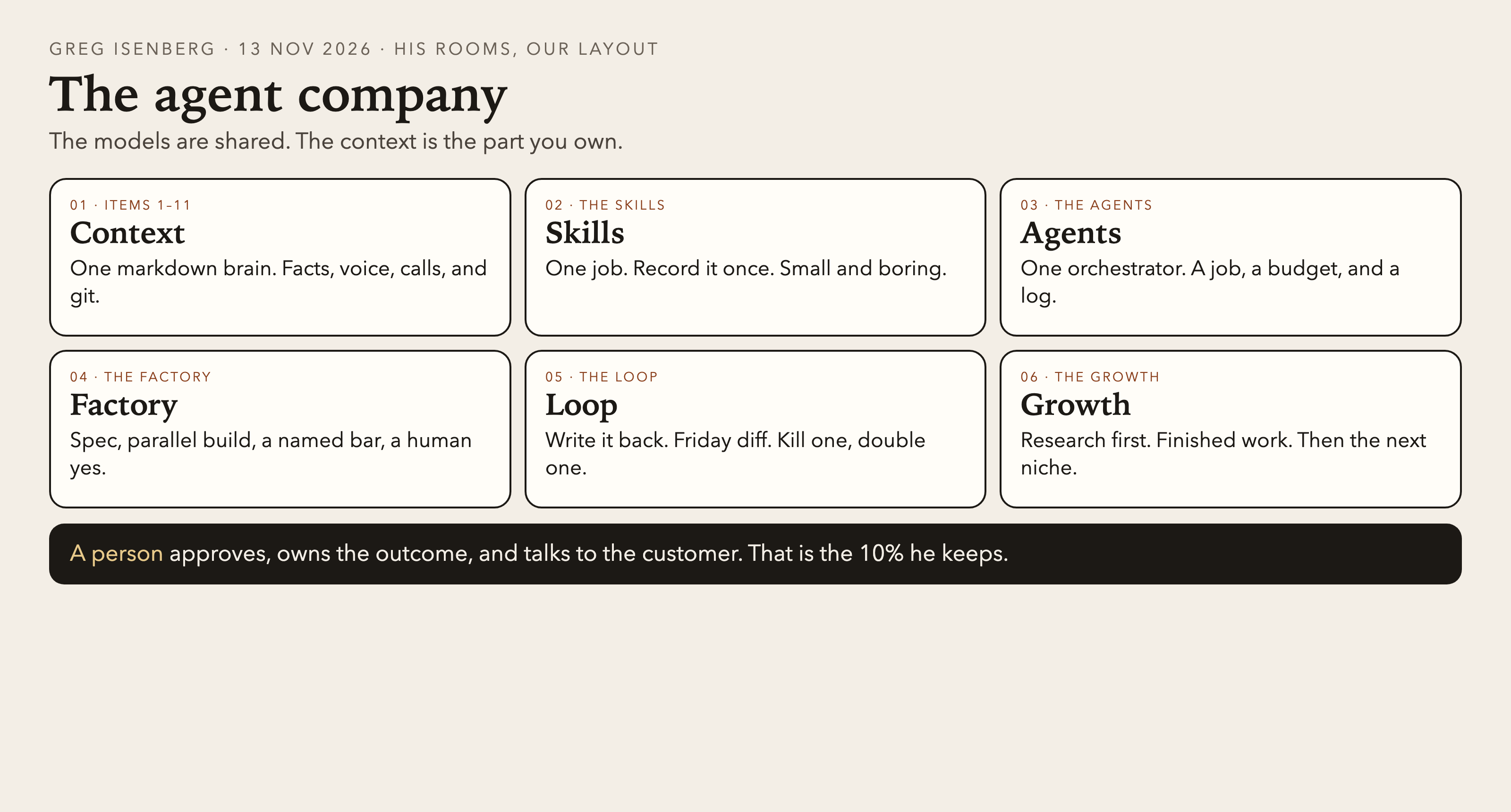
The picture on the post is a field of dots and lines, with a cursor. It is not a chart of the 49 items. The drawing below is this page’s. His tool names stay in his column. The daily loop from 3 Nov, grill then version 5, stays on /companystack. This page is the wider company.
The picture
One sentence
Put the company’s facts in files an agent can read, turn each job into one small skill, and let a person approve the diff.
1. Context
Items 1 through 11. A second brain is one folder of markdown on how he thinks, writes, and decides. He names Obsidian. Voice notes run all day through Wispr, and an agent files each fact, story, and decision. The company brain holds customers, calls, numbers, pricing, playbooks, and past decisions with the reason.
Every call and meeting is recorded in Granola, and the transcript goes into the brain. A facts file lists what agents are allowed to say. He says that file kills made-up claims. A voice file holds his 50 best posts, 20 he hates, and the words he never uses. All of it sits in git, so a change has a history.
One instruction file sits at the top, CLAUDE.md or
AGENTS.md. His rule: read these files before any
task, never overwrite, always date. Memory across sessions is
claude-mem and mem0, so an agent does not start from zero. Ads,
analytics, CRM, and payments go through Airbyte into ClickHouse,
one warehouse agents can query. The last line of the room is
the moat he claims: feed it data nobody else has, because that
is the part a competitor cannot download.
2. Skills
Items 12 through 21. He says not to start from zero. The packs
he names first: anthropics/skills,
obra/superpowers, mattpocock/skills,
and addyosmani/agent-skills. Marketing packs:
coreyhaines31/marketingskills, Cody Schneider’s
graphed skills for static ads and UGC, and the skills on
boringmarketing.com.
Then the method. Map every workflow. Rank them by money made or money saved. Do the job once while talking out loud, and record it. An agent turns the recording into a skill: when to use it, the steps, the checks, and the mistakes to avoid. One skill per job. His line: small and boring beats one giant prompt.
MCPs connect the tools so an agent can act. He names Gmail, Slack, Stripe, Linear, Notion, PostHog, and Supabase. A browser is browser-use, Vercel’s agent-browser, or Claude in Chrome. A computer of the agent’s own, for tools with no API, is Vercel’s agent-desktop or Orgo. The last skill move is public: give the best skills away. He calls that the new lead magnet.
3. Agents
Items 22 through 30. An orchestrator that never turns off. He names Grok Bot, OpenClaw, and Hermes. It manages one agent per project, and each of those runs its own sub-agents. Building is a coding agent: Claude Code, Codex, Cursor, t3, or Antigravity. A harness wraps them so they plan, test, and remember. He names ECC and superpowers.
The fleet has one home. He names Paperclip. Every agent gets a job, a budget, and a log. Skills sit on triggers, n8n or a schedule: daily, weekly, on a new lead, on a cancellation. Models are routed through OpenRouter. The expensive one plans and checks. He names Fable 5.2 and Gemini 4 Carbon. Cheap models do the volume. The token bill comes down through shorter outputs and smaller tool results. He names caveman. Data that cannot leave the machine runs on a local model. He names Gemma 4.
The room ends on a number. Track cost per job. If a job costs more than it earns, fix it or kill it.
4. Factory
Items 31 through 37. The line is a spec agent, then builder agents in parallel on git worktrees, then a test agent, then a reviewer, then a deploy. He names Vercel and Railway. Design goes through the same line on the Paper MCP, and a skill called unslop strips out anything that looks AI-made.
Two speed rules. Every annoying task in the company becomes an internal tool by the end of the day. Every customer request becomes a pull request before a human reads it. He names tstack for that pull-request workflow.
Reviewers have a named bar. His question: “would the best team in the world ship this?” Reject until the answer is yes. Keep 50 real cases with the right answer. Rerun them when a new model drops, and switch to the winner. People approve, own the outcome, and talk to customers. He calls that the 10% you keep.
5. Loop
Items 38 through 41. Every finished job writes back to the brain: what worked, what failed, what to stop doing. Support tickets, analytics, and social comments flow in every night. Every Friday an agent rewrites the playbooks from the week’s results, and a person approves the diff. Every month, rank everything by profit per human hour. Kill one thing. Double one thing.
6. Growth
Items 42 through 49. Research with agents before a dollar goes out. He names the Perplexity API and a last30days skill. Outbound finds the leads, enriches them, verifies them, and sends. He names Apollo, Million Verifier, Instantly, and PhantomBuster. The pitch he wants is finished work, sent in place of a deck.
Ads run as a loop. An agent writes the creative, publishes through the Facebook ads API, kills the losers, and scales the winners. Creative itself is agent work. He names Nano Banana for images, HeyGen and Fal for video, ElevenLabs for voice, and Lyria 3.5 and Suno for music. Every finished job becomes content: the story, the number, the prompt. Every customer makes the brain smarter for the next one. He calls that the network effect. Once the loop works, point it at a new niche. Same agents. New context.
His stack, next to ours
/companystack is the 3 Nov daily loop. This table is the 13 Nov company. “Copy” is the behavior, on tools we already run.
| Room | His stack | What we already run | Copy |
|---|---|---|---|
| Context | Obsidian, Wispr, Granola, a facts file, a voice file, git, AGENTS.md, claude-mem, mem0, Airbyte into ClickHouse. | Second brain is the private CEO OS plus a public extract.
AGENTS.md and Grok memory hold the decisions.
Granola takes the call.
This site is already in git.
| A facts file and a voice file, dated, in the repo the agents read. |
| Skills | Four starter packs, three marketing packs, one recorded job, one skill, then MCP and a browser. | Brand voice exists. The ranked “record it once” step is still a writeup. Send, delete, and publish stay behind approval on /grokbottips. | Rank workflows by money. Turn the top one into one small skill. |
| Agents | Grok Bot, OpenClaw, or Hermes. Paperclip. n8n. OpenRouter. Fable 5.2 and Gemini 4 Carbon check. Caveman shortens. Gemma 4 stays local. Cost per job. | Grok Bot CEO, OpenClaw, and Hermes are written up. Building is Grok Build, Cursor, Claude Code, and Codex, on worktrees. | One agent per project. Write the cost next to the job. |
| Factory | Spec, worktrees, test, review, Vercel or Railway. Paper MCP. unslop. tstack. A named bar. 50 cases. Humans keep 10%. | Worktrees and a person on the preview are the bench. The named bar is the taste judge on /spawnfleet and the under-8 rule on /companystack. This site deploys on Netlify. | A person approves. The customer request is read before it becomes a pull request. |
| Loop | Write-back, a nightly inflow, a Friday playbook diff, a monthly kill-one and double-one. | Field notes are the write-back a person does. No Friday agent rewrites the playbooks. | Three lines after a job: worked, failed, stop. A person approves the Friday diff. |
| Growth | Perplexity and last30days. Apollo, Million Verifier, Instantly, PhantomBuster. Finished work as the pitch. A Facebook ads loop. Then the next niche. | Product brain and the August plays are the research side. Finished work already becomes a page here. | Research before spend. Send the work. Point a working loop at one new niche. |
What we copy
This list is ours. His post names the tools. These six turn the company on with the desk we have. The 3 Nov order, grill through version 5, stays on /companystack.
- Facts, then voice, in git. One file of claims agents are allowed to say. One file of posts to sound like, posts to avoid, and words to leave out. Date the change. Do not overwrite the history.
- One instruction file.
AGENTS.mdis read before the task. A new rule is dated. The old rule stays in the history. - One skill from one recorded job. Rank the workflows by money made or saved. Do the top one out loud, once. The skill says when, the steps, the checks, and the mistakes. Small and boring.
- Cost next to the job. If the job costs more than it returns, fix it or stop it. The token bill is a line on the job, not a surprise at the end of the month.
- Write back, then a Friday diff. A finished job leaves three lines: what worked, what failed, what to stop. On Friday a person approves the playbook change. Once a month, kill one thing and double one thing.
- People keep the 10%. A person approves, owns the outcome, and talks to the customer. The thing we send is finished work. When that loop is real, the same agents get a new niche and the same files.
Stays on his list
Airbyte into ClickHouse is a warehouse we do not run. Search Console and DataForSEO stay the queryable sources for the SEO products. Paperclip, as a fleet console with a budget per agent, stays his. So do n8n as the trigger layer, OpenRouter, and the model pair he names for the check, Fable 5.2 and Gemini 4 Carbon. Caveman, Gemma 4 on the machine, unslop, and tstack stay his names.
A computer per agent is the Orgo line already left on /companystack. Email Quarterback stays a person. Send, delete, and publish stay behind approval. /gymhack is why an agent with a write credential is not the same thing as an agent with a skill. Apollo, Instantly, PhantomBuster, and the Facebook ads loop stay in his growth room. Research before spend, and finished work in place of a pitch, are the parts this page takes.
The portfolio is the one already on the site: this blog, BMOS, Headless Domains, PowerLobster, RankingSolution, and GFAVIP. Pricing for the first two stays on /futureofsaas.
A reply, kept off the list
@getnoan, 14 Nov 2026, 08:36 UTC: “a folder of markdown files is not a second brain.” That is a reply, not Greg’s claim. His post does call the folder a second brain. The useful half of the objection is already in his own items 3, 5, and 10: customers and numbers, a facts file, and a warehouse. A folder without those is notes. The reply’s product is left off this page. Other reply drawings stay off too.
Related on this site
- Company stack — his 3 Nov loop: voice note in, a person sees version 5
- Future of SaaS — his 30 Oct picture: free tool, then agents, then agency
- 23 agent growth plays — his August list, mapped onto this portfolio
- Second brain — the git-backed memory already in use
- Granola — the call that can land in the brain
- GrokBot CEO — one inbox, specialists, three daily routines
- OpenClaw · Hermes — two of the three orchestrators he names
- Claw fleet — how OpenAI fences the OpenClaw half
- Grok Build worktrees — the parallel build we keep
- Spawn fleet — taste judges, and the human jobs
- Product brain — research before the build
Primary: @gregisenberg, 13 Nov 2026
Comments
Approved comments appear below. Log in once with GFAVIP — it applies across the whole site. GFAVIP login
View comments archive