Company stack
Greg Isenberg wrote down how Late Checkout runs. A voice note goes in. A person sees version 5.
← AI Agents · AI · Productivity · Future of SaaS · His 23 growth plays · What we copy
The post
Greg Isenberg (@gregisenberg), 3 Nov 2026, 21:45 UTC. On the post page at capture on 7 Nov: about 5.8k likes, 481 reposts, 566 replies, 16k bookmarks, and 726.7k views. The page rounds the likes, the bookmarks, and the views. He runs Late Checkout and the Startup Ideas Podcast, and he builds companies including IdeaBrowser.
The post is one list. He opens it with a 50-person team in 12 countries, and with the line that he talks to his agents more than to his human teammates. He closes it with two lines worth keeping: “humans get version 5, not my voice note,” and “running a company is now voice notes and inference.”
The 50 people and the 12 countries are Late Checkout. This page keeps his tool names in his column. The drawing, the comparison, and the copy list are this page’s.
The picture
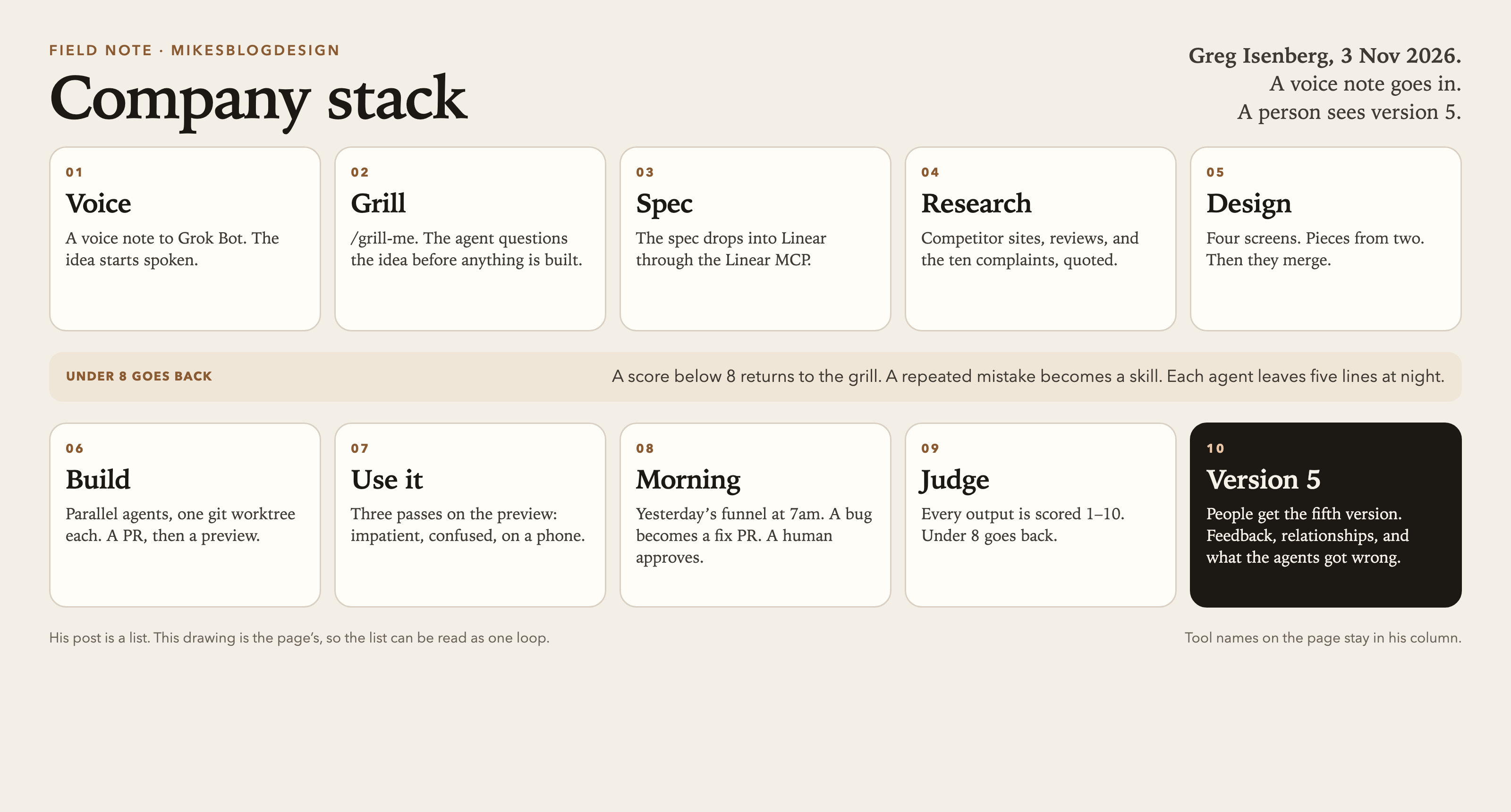
His list, in his order
He splits the day into idea, design, build, user testing, bugs, data, the agents’ tools, skills, a few tricks, and the human team.
Before anyone builds
- A voice note to Grok Bot.
- mattpocock/skills
/grill-me, so the agent questions the idea before anything gets built. - The spec drops into Linear through the Linear MCP.
- Exa and Firecrawl read every competitor site, pricing page, and changelog.
- IdeaBrowser for ideas and trends.
- Apify pulls G2, Reddit, and app-store reviews.
- His prompt: “find the 10 complaints that show up most and quote the users.”
- Context7, so the agent reads the latest docs before it touches an API.
Design, then build
- Claude Code plus Paper MCP. Four versions of every screen before a line of code.
- Pick pieces from two. It merges them. His phrase is “diverge then converge.”
- The frontend-design skill from anthropics/skills, plus their own design-system skill.
- A CleanShot of a UI he likes, with the line “make it feel like this.”
- pingdotgg/t3code is the control surface for every agent, including from his phone.
- stablyai/orca runs a fleet in parallel, each agent in its own git worktree.
- Graphify maps the codebase into a knowledge graph.
- Headroom compresses tool output before it hits the model. He says tokens go 20–95% further.
- LSP plugins, so the agent sees types and errors the way an IDE does.
- A security guidance hook flags risky edits before they land.
- Supabase MCP for the database. Stripe for billing.
- GitHub MCP opens the pull request. Vercel spins up a preview.
- Loops run overnight. He checks what shipped over coffee.
Someone uses it, then the numbers
- Lightpanda as the headless browser. He says it is light enough to run hundreds at once.
- Agents click every flow on the preview like a first-time user.
- One persona is impatient, one is confused, one is on a phone.
- Playwright and Chrome DevTools MCP for regression tests.
- Sentry MCP catches the error. The agent reads the stack and opens a fix PR. He says under 10 minutes. A human approves.
- A PostHog MCP cron at 7am on yesterday’s funnel.
- Any step that drops more than 10%: the agent watches 20 session replays and tells him why.
- Stripe MCP pulls every cancellation reason into one doc every Monday.
Tools, skills, and the people
- Orgo, so every agent gets its own computer.
- AgentMail, so every agent gets its own inbox.
- AgentPhone, so he can call them from the car.
- Composio for every other connector.
- akitaonrails/ai-memory, a git-backed markdown wiki, so they remember last week’s decision.
- wshobson/agents, so skills work across Claude Code, Codex, and OpenCode.
- Skills he names: his writing voice, the design system, how they write specs, and a skill creator so agents write the next skill.
- One agent per platform. “The X agent never touches email.”
- A cheap model for triage. Opus for anything that ships.
- Every output is scored 1–10 by an LLM judge. Under 8 goes back.
- Every agent writes a 5-line log at night, so he can read the whole company in 2 minutes.
- Every agent mistake becomes a new skill, so it only happens once.
- Humans get version 5. Their job is creative feedback, relationships, and telling the agents what they got wrong.
- A human PM reviews the funnel once a week. His loop reviews it every morning.
Reply diagrams under the post are other people’s drawings. One line worth keeping apart, from @dcdigit: “Agents are the first coworkers I've had who actually read the whole ticket.”
His stack, next to ours
The June coding-stack page stays the code half: GitNexus, lossless context, QuadDesign, and an OpenClaw fork, at /ai-agent-coding-stack-gitnexus-lcm-od-cd. This table is the company half. “Copy” is the behavior, on tools we already run.
| Stage | His stack | What we already run | Copy |
|---|---|---|---|
| Front door | Voice note to Grok Bot. /grill-me. Spec in Linear. | Granola after a call. Grok Bot. Plan mode. The idea often stays in the chat. | Grill it. Land the spec in the tracker before a build. |
| Research | Exa, Firecrawl, IdeaBrowser, Apify. Ten complaints, quoted. Context7 before an API. | Product brain is the method. Search Console and DataForSEO cover the SEO products. | Ten quoted complaints, then a docs check, before implementation. |
| Design | Paper. Four screens. Pieces from two, then a merge. A design-system skill. A screenshot plus “make it feel like this.” | QuadDesign is named on the June page. Field notes still ship one picture. | Four versions. Keep pieces from two. Point the merge at our CSS. |
| Build | t3code, Orca worktrees, Graphify, Headroom, LSP, a security hook, Supabase, Stripe, GitHub, Vercel, overnight loops. | Grok Build worktrees. Cursor on the same tree. Claude Code and Codex. GitNexus. Netlify previews. Auto-review on send, delete, publish, and keys. | Keep this plane. Test the preview URL. |
| Use it | Lightpanda, at his scale of hundreds. Impatient, confused, on a phone. Playwright and DevTools. | Agentic setup already says the agent runs the app. We check the screen we changed. | Three passes on one preview. |
| Morning | Sentry opens a fix PR, he says in under 10 minutes, and a human approves. PostHog at 7am. A drop over 10% means 20 replays. Stripe cancellations, one doc, every Monday. | The morning exception is still a person opening a tab. | One 7am note on the step that moved. Monday, cancellation or refund reasons in one doc. |
| Memory | A git-backed markdown wiki. One skill pack for Claude Code, Codex, and OpenCode. Voice, design system, spec format. One agent per platform. Cheap model for triage, Opus to ship. |
Brand voice exists. AGENTS.md, Grok memory, and the private CEO OS split the decisions.
One agent per platform is already the rule on
/grokbotsocial.
| One skill pack those three can read. Decisions stay where they already live. |
| The gate | Score 1–10. Under 8 goes back. Five lines at night. A mistake becomes a skill. Humans get version 5. | Taste judges are written up on /spawnfleet. The score, the night log, and the mistake-to-skill step are still a writeup. | Score it. Under 8 goes back. A person sees version 5. |
What we copy
This list is ours. His post names the tools. These eight are the order to turn the loop on, using the desk we have.
- Grill before build.
A voice note, or a Granola dump, goes to Grok Bot.
/grill-meruns. The spec lands in the tracker. The build starts from the spec. - Quote ten complaints, then read the docs. On the next product idea, one pass returns the ten complaints that repeat, in the customer’s words. An agent reads current docs before it calls an API the repo does not already contain.
- Four screens, then code. The next real UI gets four versions. Keep pieces from two. The merge uses our CSS. That file is the design-system skill.
- Keep Grok Build and GitNexus. Worktrees already do the parallel-agent job. GitNexus already does the code-graph job. The thing that gets tested is the preview URL. The deny list (keys, send, delete, publish) becomes a skill Claude Code and Codex load too.
- Three passes on one preview. Impatient, confused, and on a phone. One browser.
- Score it. 1–10. Under 8 goes back. A person sees version 5. This is the taste-judge gate from /spawnfleet, turned on.
- A two-minute morning read. One 7am note on yesterday’s funnel or Search Console, and only the step that moved. Each agent that ran leaves five lines. Where a product already records errors, one repo gets “error to a draft pull request, a human approves.” Monday, cancellation or refund reasons from that product’s billing go into one doc.
- One skill pack. Writing voice, spec format, and the design system live where Claude Code, Codex, and Grok all read them. The next repeated correction becomes a skill that week.
Stays on his list
A computer, an inbox, and a phone for every agent are his Orgo, AgentMail, and AgentPhone lines. /computeruse and /bland already cover that shape. Email Quarterback stays a person until an agent inbox is read-only. /gymhack is why that inbox does not send.
Orca and Graphify do jobs Grok Build and GitNexus already do. Supabase, Stripe, Vercel, PostHog, and Sentry show up where a product already uses them. Lightpanda at hundreds of browsers is his scale. Three passes on one preview is ours.
The portfolio this loop is for is the one already on the site: this blog, BMOS, Headless Domains, PowerLobster, RankingSolution, and GFAVIP. The pricing picture for the first two stays on /futureofsaas.
Sources
- @gregisenberg, 3 Nov 2026 — the list. Counts above are from the post page on 7 Nov, and the page rounds three of them.
- @dcdigit, 3 Nov 2026 — the reply quoted above. Other reply drawings are left off this page.
Related on this site
- Future of SaaS — his 30 Oct picture: free tool, then agents, then agency
- 23 agent growth plays — his August list, mapped onto this portfolio
- AI agent coding stack — the June code half: graphs, context, output design
- Agentic setup — Jamon’s checklist, including “the agent runs the app”
- Grok Build worktrees — the parallel-agent bench we keep
- GrokBot CEO — one inbox, specialists, three daily routines
- Product brain — the research method behind the ten complaints
- Spawn fleet — taste judges, and the two human jobs
- GrokBot social — one agent per platform
- Granola — the call that can become the voice note
- Second brain — the git-backed memory we already have
Comments
Approved comments appear below. Log in once with GFAVIP — it applies across the whole site. GFAVIP login
View comments archive