Future of SaaS
Greg Isenberg put the model in one picture. The tool gets cheap. The invoice moves to agents, then to people.
← E-commerce · AI Agents · AI · His 23 growth plays · BMOS + Headless Domains
The post
Greg Isenberg (@gregisenberg), 30 Oct 2026, 16:57 UTC. About 739 likes, 45 reposts, 27 quotes, 198 replies, 1,029 bookmarks, 74,685 views at capture on 31 Oct. He runs Late Checkout and the Startup Ideas Podcast, and he builds companies including IdeaBrowser, LCA, and Boring Marketer.
The whole post is three lines under one picture:
- Give away SaaS for free (or close to it)
- Upsell AI agents
- Upsell agency services
He quote-tweeted his own note from the day before, 29 Oct 2026, 21:08 UTC: “SaaS is dead. I advise the world’s biggest companies on SaaS and I’ll tell you where it’s going and how it evolves in 11 minutes.” That attachment is a video of about 11 minutes. The image is the claim this page keeps. The video is still his eleven minutes.
The picture
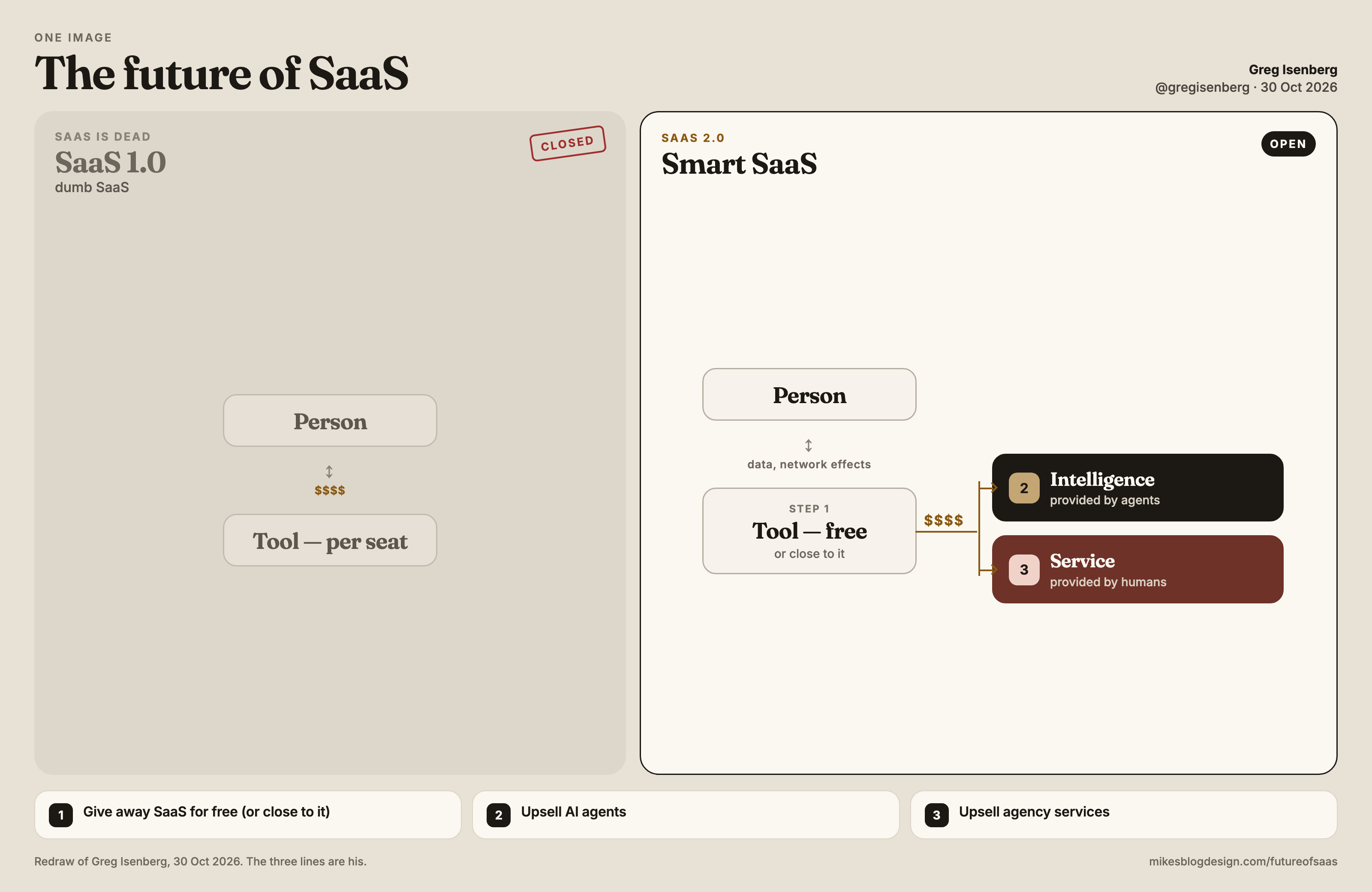
His original is an Excalidraw frame. A red cross sits over the left column. The right column is the model he is arguing for. A still of him is pinned in the corner because the frame is a screen recording.
How the two sides read
SaaS 1.0, dumb SaaS. He marks this “saas is dead.” A person and a tool. The tool is sold per seat. Money moves between those two boxes. The login is the product.
SaaS 2.0, smart SaaS. The person is still there. The tool is free. What moves between the person and the tool is “data, network effects.” The money leaves that pair. It splits. One paid box is “Intelligence provided by agents.” The other is “Service provided by humans.”
Read against the caption, the free tool is step 1, the agent box is step 2, and the human box is step 3. The seat used to be the invoice. In this picture the seat is the way in, and the invoice is the work that used to sit on top of the seat.
What the replies added
These are replies under the post. His drawing is the model. The replies came after.
- Pulkit Saini (@pulkit_rc): “SERVICE-AS-A-SOFTWARE is where this is all going.”
- Mees Tierolff (@meestierolff) asked about performance-based SaaS: give the tool away, collect users and data, then charge on a business result such as customers acquired or revenue. Pay nothing until there is a result.
- Pedro G (@pggalaviz): the SaaS becomes the free sample, and the real business is selling hours again, after fifteen years of trying to leave agency margins.
For the team: BMOS and Headless Domains
His picture, applied to buildmyonlinestore.com and headlessdomains.com. The offer, in one sentence:
Free catalog, cheap name, a paid agent that sells, and an optional human who connects the store and signs the policy.
BMOS is already the free tool. Headless Domains is still mostly the seat. The invoice the pair is missing is one agent that runs a merchant’s catalog under that merchant’s name. A person shows up for the setup a merchant will not do.
1. The free layer is the pair
A merchant publishes a catalog on BMOS. The homepage already says
the catalog is free to create. The merchant’s selling agent holds
a .agent name. On the Headless Domains
.agent page,
an agent registers that name for 1 Gem a year, about $0.52. A
person registers it for 50 Gems a year, about $26. Renewals are
the same flat rates. The live page is the price.
The feed attaches to the name. Another agent can resolve the name, read the offers, and hit a checkout the merchant already approved. Every new merchant makes both directories more worth querying. That is his “data, network effects” arrow. The publish step stays free, because a charge there taxes the loop.
2. The agent is the invoice
One store agent per merchant. It keeps the BMOS feed true. It
speaks only from that feed. It answers as the .agent.
It hands checkout to the path the merchant already approved:
Shopify, WooCommerce, or machine checkout.
Price it per live store, or on the orders the agent actually touches. The second one is the performance price from the replies: the merchant pays when the agent does the work. The catalog software and the domain stay the way in. PowerLobster stays the place spending limits and revoke live. It does not become a second seat.
3. The human is the first setup
Connect the existing store. Decide what the agent is allowed to say. Check the name. Set the policies. Confirm the first checkout. That is a fixed engagement, not a pile of theme hours.
Agencies are already a BMOS audience, so this box can be sold two ways. We do that setup. Or an agency is the service layer, running on a free catalog and a cheap name. The second one keeps our invoice on the agent, and leaves store-building hours with the agency that already wants them.
What “or close to it” means here
| Layer | Product | Price |
|---|---|---|
| Tool | BMOS catalog and feed | $0 to publish |
| Tool | .agent name, registered by an agent | 1 Gem / year, about $0.52 |
| Fence | .agent name, registered by a person | 50 Gems / year, about $26 |
| Invoice | Store agent | Per live store, or on orders it touches |
| Invoice | First setup | Fixed engagement, optional |
The $0.52 agent registration is the right price for the name. The $26 human price is the fence against squatters. Renewal revenue on the name is a cheap seat. The company is the store agent, plus the setup.
His earlier list, the 23 agent growth plays, stays on /agentgrowth. This section is the pricing picture for these two products. The rest of the portfolio is still open.
Sources
- @gregisenberg, 30 Oct 2026 — the image and the three lines. Counts above are at capture.
- @gregisenberg, 29 Oct 2026 — the “SaaS is dead” video he quoted, about 11 minutes. Not transcribed here.
Related on this site
- BMOS — the free catalog in the team section above
- PowerLobster — spending limits and revoke for the store agent
- 23 agent growth plays — his August list, mapped onto this portfolio
- Dual-rail — build and go-to-market in the same sitting
- Product brain — per-product research that keeps running
- Agentic SEO loop — one loop with a judgment step and a way to undo it
- Customer avatar — who the free tool is actually for, before the upsell
Comments
Approved comments appear below. Log in once with GFAVIP — it applies across the whole site. GFAVIP login
View comments archive