Claw fleet
How OpenAI runs persistent OpenClaw agents. The post is Peter Steinberger’s team. The numbers below are theirs. The drawing is ours.
← AI Agents · AI · Tech · OpenClaw setup · Security desk · Gym hack
What this is
Kevin S Lin (@kevins8) posted on 12 Nov 2026, 19:31 UTC, that OpenAI was sharing how they manage fleets of claws. His bio says OpenClaw enterprise at OpenAI. The link is Securing persistent agents like OpenClaw at OpenAI, dated 12 Nov 2026 on the Codex blog. The page has no byline.
At capture on 15 Nov 2026 that post had 956 likes, 80 reposts, 24 quotes, 48 replies, 2,116 bookmarks, and 177,786 views.
Peter Steinberger (@steipete) quote-tweeted it on 13 Nov 2026, 01:53 UTC: “My team wrote about how we run persistent agents inside OpenAI.” At the same capture: 1,507 likes, 79 reposts, 14 quotes, 156 replies, 1,096 bookmarks, 160,416 views. He adds no control in that post. The sentence is the attribution.
Peter joined OpenAI in February 2026 to work on personal agents, and OpenClaw moved to a foundation. Gizmodo, 16 Feb 2026, quotes Sam Altman on the role and Peter on the foundation. The OpenClaw account pointed at the same essay that evening (12 Nov, 20:36 UTC). Vincent Koc, chief architect at OpenClaw, amplified it the next morning. His bio puts him at the project. This page does not put him on the OpenAI payroll.
Kevin’s post names two products in the same problem: OpenClaw, and Dots. Dots are OpenAI’s always-on ChatGPT agents, announced at DevDay on 29 Sep 2026 (Wired). The controls in the essay are the OpenClaw deployment.
The picture
One sentence
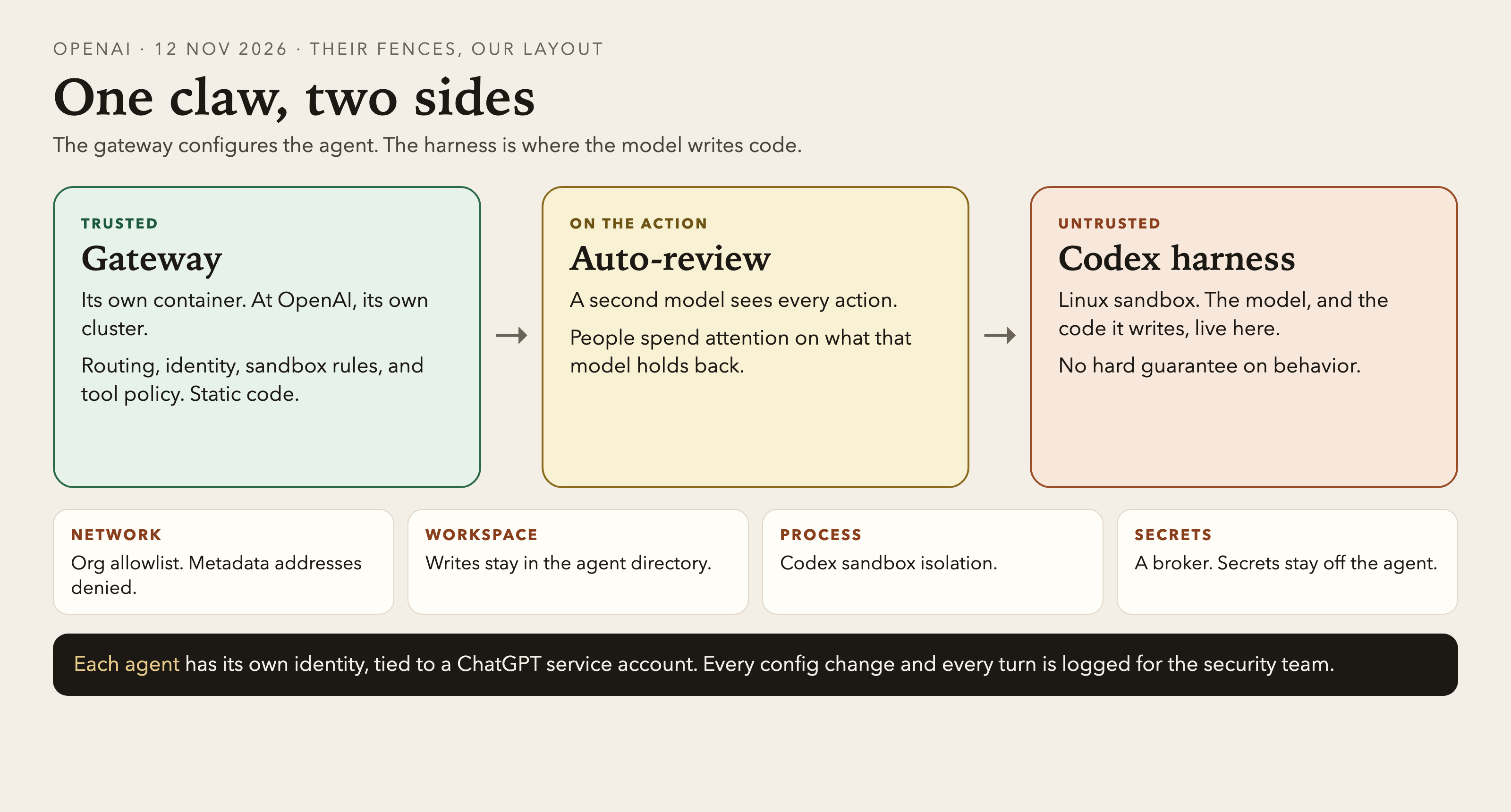
Treat the gateway as code you can configure, treat the agent and anything it writes as untrusted, and give every agent an identity you can turn off.
Why a claw is a contractor
Kevin’s frame, in the post: persistent agents are closer to contractors than to SaaS. They act in the background, they can cover a whole job, and they can take a misaligned action or write code the operator did not plan.
The essay says the old assumption was that configuration and code stay deterministic, and that the attacker is outside. A persistent agent can change its configuration and write code to finish a goal. The attack they are writing about comes from the inside, when the agent’s action is misaligned.
A Codex session, in their contrast, has a fixed goal and a person steering. A persistent agent runs around the clock, with a broad scope, and can act before anyone types.
Five controls
| Control | What they say they do |
|---|---|
| Split the process | Gateway in one container. At OpenAI, in another cluster from the harness. Gateway is trusted. The agent, its environment, and the code it writes are untrusted. |
| Hard sandbox | Codex Linux sandbox. Network allowlist, writes limited to the agent workspace, process isolation, secrets through a broker. |
| Auto-review | A second model on every agent action. Human attention stays on the approvals the reviewer holds back. |
| Its own identity | Each agent has an identity tied to a ChatGPT service account, with its own inference credential. Inference for that agent can be turned off. |
| Logs | Every control-plane config change, and every agent turn. The logs are restricted to a few people on the security team. |
Gateway on one side, harness on the other
Trusted logic, in the essay, is networking, identity, and sandboxing. That code should behave as configured, bugs aside. The agent side has no hard guarantee, because the model can generate code to reach a goal.
They added remote harness execution to the open-source project so the OpenClaw gateway could run apart from the harness. The gateway is the component that configures the agent. Once it was apart, they could sandbox the workload.
The enterprise docs, read 15 Nov 2026, fill in the storage split. The gateway owns routing, session admission, tool policy, and reply delivery. The harness owns the model call and its local file and command tools. The harness does not mount gateway conversations, databases, or channel credentials.
Same page, a smaller deployment than OpenAI’s: “Remote does not require two clusters.” The ordinary Kubernetes shape is separate pods, service accounts, and storage in one tenant namespace. Two clusters are a placement choice. OpenAI’s essay says their run uses the separate cluster.
The sandbox they published
Four fences, in their words. Network: an organization allowlist, plus explicit denials. Workspace: writes only in agent working directories. Process: the Codex Linux sandbox. Secrets: a credential broker, so the secret is not visible to the agent.
The admin ceiling is requirements.toml. The run
config is config.toml. The full snippet is in the
essay. The decisions that matter:
allowed_sandbox_modes = ["read-only", "workspace-write"]
allowed_web_search_modes = ["cached"]
experimental_network.managed_allowed_domains_only = true
danger-full-access is off the allowed list. Web
search is the cached mode, which they say goes through OpenAI’s
own index. Live hosted search is absent from the allowed modes.
User config cannot add domains. The proxy is required.
The published allowlist example is github.com,
api.github.com, and codeload.github.com.
The comment says to replace those hosts with the ones that
workload needs. The denials in the same snippet are
pastebin.com, webhook.site,
metadata.google.internal, and
169.254.169.254.
Files, in the openclaw permission profile: read
on the minimal runtime, write on
/home/dev-user/openclaw-workspaces, read on
/home/dev-user/read-only, deny on
/home/dev-user/.ssh.
The proxy block turns off an upstream proxy, local binding, SOCKS, a listener off loopback, and unrestricted Unix sockets. Apps are off unless someone enables one. Destructive app operations and open-world app operations start off.
GitHub tokens are stripped from the command environment:
GH_TOKEN, GITHUB_TOKEN,
OPENCLAW_GITHUB_BASIC_AUTH, and
OPENCLAW_GITHUB_READONLY_BASIC_AUTH. Their comment
on that list is the most useful line in the file:
# This does not hide credentials stored in accessible files.A token in a file the workspace can read is still a token the agent can read. The env filter does not cover that.
A second model on every action
The sandbox is static. Their next line is that defenses have to scale with the model, which means another model. Auto-review is a second agent that monitors and approves the first. They say a person who approves every prompt learns to approve all of them. The reviewer is the filter. People see the high-value leftovers. OpenClaw and Codex both ship the feature. On this deployment they enforce it on all agent actions.
Grok Bot has a setting with the same name. That dial lives on /grokbottips. It is a different product. The OpenAI control in this essay is a second model on the OpenClaw fleet.
One identity per agent
They want an audit trail, access to resources, and a way to tell an agent’s action from a person’s. The essay names two drafts. WAG is for an agent’s own access. XAA is OAuth delegation, the agent acting for a person. They say agent identity and a service account are different, and that you use both: the agent acts as itself, and third-party access goes through a service account linked to that identity.
On their fleet, each agent’s identity is tied to a ChatGPT service account. That account is the inference credential, separate from the person’s. Teams can attach custom plugins to the agent. The same identity is how they audit, and how they turn inference off for one agent.
Logs a few people can open
They log the life of the agent: how it was configured, and what it did. For this deployment that is every configuration change on the control plane and every turn. Turns can hold sensitive text, so the log store is limited to a few people on the security team.
How many, and what they do
Two counts, left as written. The opening says persistent agents run across the company, “including hundreds of OpenClaw agents.” The close, in the paragraph about the internal OpenClaw pilot, says “over 500 agents” now run in the background. This page does not collapse those two sentences into one headcount.
The work they name in that close: opening pull requests from product feedback, and running data experiments on new features. They also say the pilot produced a large jump in productivity and adoption, on technical and non-technical teams. No percentage is attached.
A named agent sits in an earlier post. On 29 Sep 2026, the OpenClaw Enterprise announcement quotes RJ Marsan, a member of the technical staff at OpenAI, on an internal agent called Androidclaw. In that quote it triages channels, finds the pull request behind a broken build, answers a missing-tab report with an incident link in about 30 seconds, and, for a “streaming seems glitchy” report, traces it, opens a pull request with video, and merges. That quote is from the September announcement. It is not in the 12 Nov essay.
The public preset is a smaller circle
The essay points at OpenClaw Enterprise, announced at DevDay, as the open control plane. It started at OpenAI, was donated to the OpenClaw Foundation, and is developed with Red Hat and NVIDIA. It is free to self-host, still a pilot, with a 1.0 aimed at the end of 2026. Office hours are listed on openclaw.ai/enterprise.
The essay says the standard Codex preset launches an agent with many of these safeguards built in. The preset doc, read the same week, draws a tighter boundary and says so. Both stay on the page.
| Inside OpenAI, 12 Nov essay | Standard Codex preset, read 15 Nov | |
|---|---|---|
| Split | Gateway in its own container and, for them, its own cluster. | A dedicated Codex harness and a separate gateway. Ordinary Kubernetes is two pods in one namespace. |
| Ceiling | requirements.toml leaves read-only and workspace-write. danger-full-access is not an allowed mode. | The template requests workspace-write. The doc says a preset is an editable copy and is not an administrator-enforced ceiling. |
| Network | Org allowlist. User config cannot add domains. Metadata addresses are denied. | A build-host allowlist, traced 24 Sep 2026 while compiling the project. The doc calls it a launch template. On Kubernetes the Codex pod still has public TCP/443. |
| Search | Cached only. | Cached. The doc says to keep the restricted profile so Codex does not promote that to live search. |
| Review | Auto-review on every action. | approvalPolicy: on-request, and approvalsReviewer set to the user. |
| Secrets | A credential broker. Named GitHub variables stripped from the environment. Files the agent can read are still visible. | The model key is a Secret on the harness. The doc says that credential belongs on the harness. |
| Identity and logs | A ChatGPT service account per agent. Turns logged for a few people on the security team. | Gateway runtime credentials and a model secret. The preset doc does not describe that service account, or a security-team lock on the logs. |
One more line from the preset doc: if you select the OpenShell
sandbox driver, it drops this network proxy and selects full
access. OpenShell’s egress policy is the bound in that case.
The template is a starting draft. The essay’s
requirements.toml is the ceiling they say they
enforce inside OpenAI.
Replies, kept off the essay
Kevin answered two questions after the post. Those answers are his, and they are not in the blog.
- 13 Nov 2026, 15:29 UTC (2121264100936450223), on giving a contractor a scope and an end date: “entra hooks to shutdown agents for individuals that have left and observably of usage across the fleet to find stale or suspicious agents.” The wording is his. The mechanism he names is offboarding when a person leaves, plus fleet usage as a way to see an agent that has gone quiet or looks wrong.
- 14 Nov 2026, 00:56 UTC (2121406853993337291), on issuing credentials per agent: “we have existing service to do it. its the same service that we use for managing plugin credentials in chatgpt.”
@Margikbaxi asked, on 13 Nov, how they bound actions in an energy plant where a bad write can trip a unit, and how an agent stays useful with no write access to control systems. At capture, that reply had no answer from Kevin.
@heyneighbor pointed Peter’s quote at an interview with Kevin and at the bi-weekly office hours. The interview is not transcribed here.
On this stack
We do not run OpenClaw Enterprise, and we do not run a second cluster for the gateway. The pieces that transfer:
- The process that holds channel tokens is a different trust level from the process that writes code. The Mac Mini guide on /openclaw still puts both on one machine. The closest fence already written down is a box the public internet cannot log into, /aiagentvps.
- Secrets stay in the login keychain, /keychain. Stripping a token from the environment still leaves a token sitting in a file the workspace can read. Their comment says that.
- One credential per agent, and a person who can turn that agent off. That is the same shape as /security: one key per place, a human on revoke.
- OpenAI’s auto-review is a second model on every action. The Grok Bot dial on /grokbottips stays on Require Approval for send, delete, and pay.
- A turn log a person can open. We do not have their security-team store. The log is still the thing you read when an action looks wrong.
- /gymhack is the failure their network fence is about. An agent with a booking API did a write the operator did not mean. An allowlist is the fence. A prompt is not.
Related on this site
- OpenClaw setup — the Mac Mini install. Gateway and harness share the machine.
- Gym hack — a useful agent, a write nobody asked for.
- Security desk — keys, patches, and hiding the origin.
- AI agent VPS — one box, Tailscale only.
- macOS Keychain — the secret stays out of the chat.
- GrokBot tips — a different Auto-review, on the Grok Bot dial.
- Spawn fleet — another company’s agents, another set of gates.
- Codex engineering — the harness side, from an earlier OpenAI talk.
- OpenAI × Hugging Face — an agent eval that walked out of the lab.
Primary: OpenAI, 12 Nov 2026 · @kevins8 · @steipete
Comments
Approved comments appear below. Log in once with GFAVIP — it applies across the whole site. GFAVIP login
View comments archive