Claude Code Meetup Notes · Chiang Mai, Thailand
AI-Native GTM: Agents, Lead Data and Outreach at Scale
What I learned from Eishant’s go-to-market talk on Friday, July 10, 2026
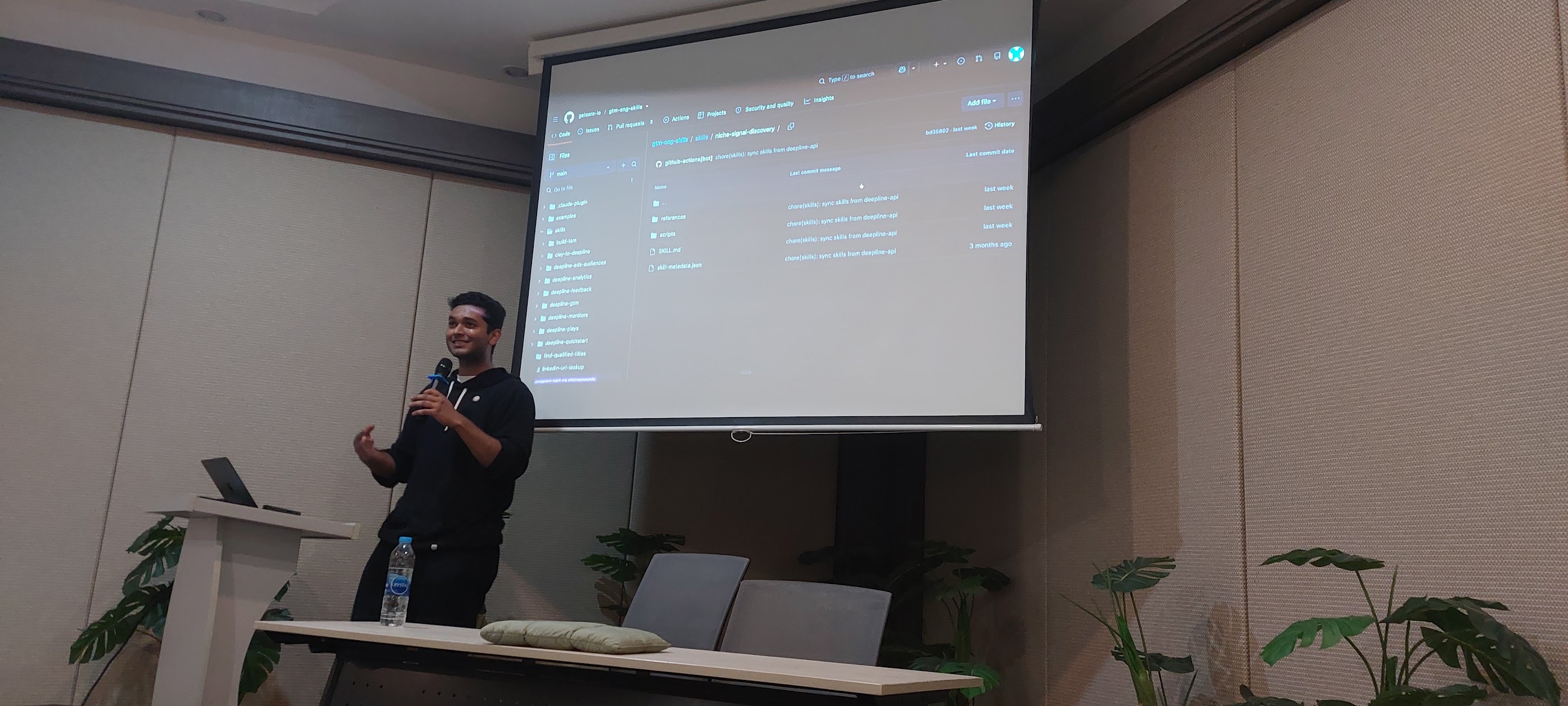
GTM Is the New AI Hype Cycle
I went to an AI meetup in Chiang Mai and the topic was GTM — go to market. It feels like this is becoming the next big part of the AI cycle: not just using agents to build a product, but using agents to continuously find the right people, enrich the data, start conversations and report what is working.
The speaker, Eishant, had deep experience in this area. My biggest takeaway was that AI-native GTM is less like running a one-time campaign and more like building an always-on system.
The Stack: Sources → Deepline → Your Agent
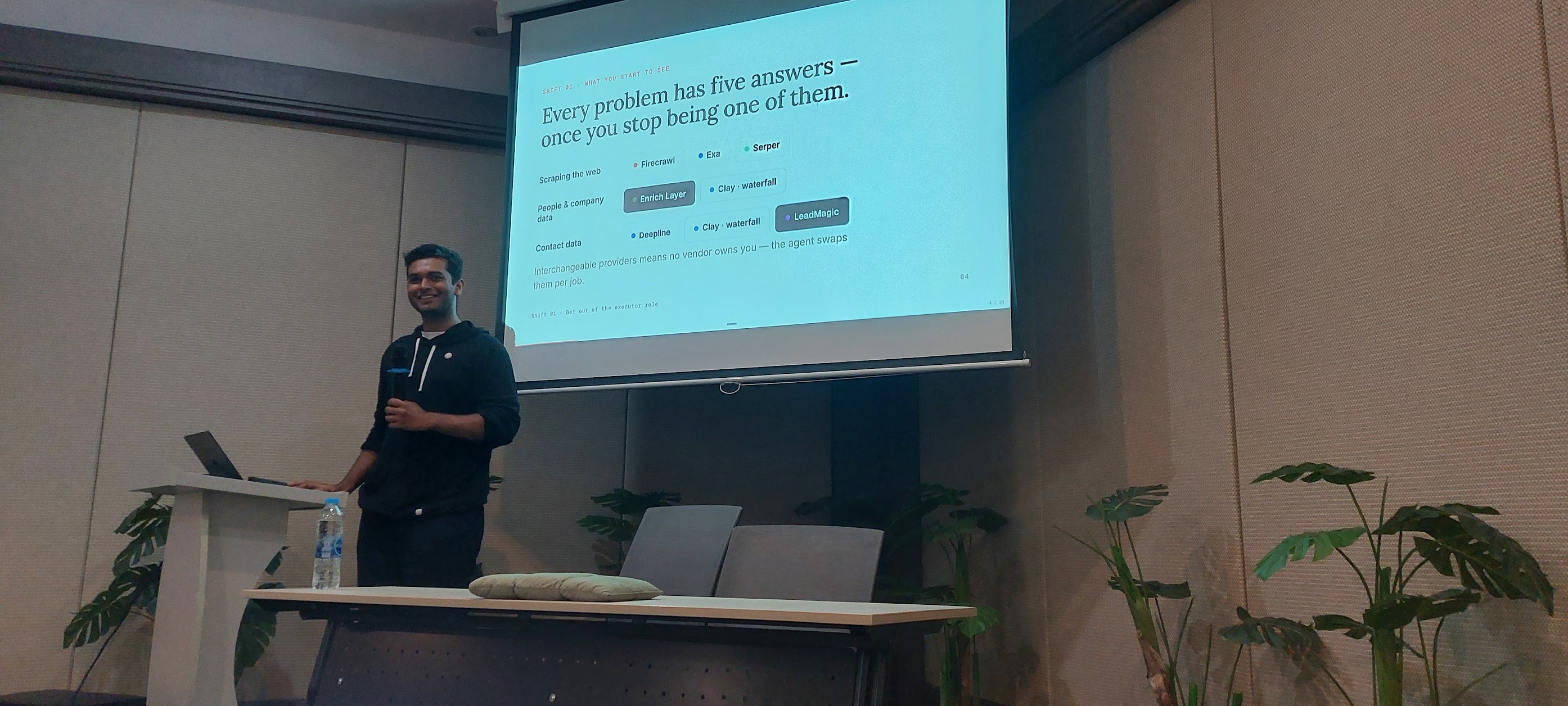
Eishant recommended Deepline as the connection layer. A service such as GetLeads can be one source of prospect data, while Deepline connects across many different sources and channels.
Deepline adds a markup to data requests, but his view was that the extra cost is small compared with the power and convenience of having one layer that can reach across multiple providers and platforms.
The suggested setup was to connect Deepline to Claude Code, Codex or another coding agent, then work through a reusable Deepline GTM skill. The skill helps you define the ideal customer avatar and the rest of the go-to-market process in conversation with the agent.
Enrichment Makes the Lead Useful
A name and email address are not enough. The next step is data enrichment: adding company information, role, interests, recent activity, buying signals and other context that can help the agent decide whether the lead fits — and what a relevant message might say.
This turns a raw list into a useful working dataset. It is similar to the principle behind my DataForSEO setup: specialized sources provide the raw data, while an agent-accessible layer makes it usable inside a broader workflow.
The Numbers That Surprised Me
The cold-email response benchmarks Eishant shared were much lower than I expected:
That is crazy — but it also explains why so many people give up. If you stop after sending 10 or 50 emails, you may not have sent enough to learn anything. The lesson was not to spam people; it was to understand the scale involved, improve targeting and enrichment, and judge performance from a meaningful sample.
At the same time, deliverability, consent, platform rules and local anti-spam laws still matter. An agent should not be a license to send careless messages. Better data and relevance should raise the quality of outreach, not just the volume.
The Always-On GTM Loop
- Listen: Regularly watch Reddit, social networks, data platforms and other channels for signs of a relevant lead.
- Qualify: Compare each prospect with the ideal customer avatar.
- Enrich: Add enough context to understand the person, company and likely need.
- Reach out: Draft or send a relevant message through the approved channel.
- Report: Record activity, replies and conversion signals.
- Improve: Use the results to refine the avatar, sources and messaging.
This connects closely with my notes on Distribution Engineering: distribution is becoming infrastructure. It also resembles the agent loops I wrote about in Building AI Agent Loops & Workflows — a recurring system that observes, acts, reports and improves.
No UI Required?
One of Eishant’s more provocative points was that you may not need a traditional dashboard. The agent can report directly in the local chat and maintain Markdown files with the analytics, outreach logs and periodic summaries.
I can see the appeal: instead of clicking around a new SaaS interface, you ask the system questions in plain language. “What sourced leads replied this week?” “Which avatar is converting best?” “What should we change in the next batch?” The chat becomes the interface, while the Markdown reports remain readable, portable records.
I would still want structured source data and audit logs underneath it. But for a founder or small team, the conversational layer could replace a surprising amount of dashboard work.
My Practical Takeaway
The shift is from doing isolated outreach to operating a learning loop:
Find leads continuously. Enrich them. Let agents handle the repetitive work. Track enough volume to learn. Keep the results in local, durable reports.
The tools may change, but that architecture feels durable. The advantage is not one magical email; it is a system that keeps listening, testing and getting better.
Comments
Approved comments appear below. Log in once with GFAVIP — it applies across the whole site. GFAVIP login
View comments archive