Dreaming: Self-Improving AI Agents
Background Memory Consolidation for Claude Agents (Anthropic)
Source: Original tweet/video (presented at AI DevCon by an Anthropic engineer).
What is "Dreaming" in AI Agents?
"Dreaming" is a powerful feature in Anthropic's Claude Managed Agents that makes AI agents self-improving over time.
Simple Analogy: Just like humans consolidate memories, spot patterns, and learn from experiences while sleeping (without actively "working"), AI agents use Dreaming as a background process to review their past work and get smarter — without needing to be "awake" or in an active session.
How Dreaming Works (Step by Step)
Multiple agents (or the same agent across sessions) generate logs/transcripts of their daily work — conversations, tool uses, decisions, outputs, successes, and failures.
This is the current "knowledge base" or memory the agent relies on (like a CLAUDE.md file, project notes, skills, preferences, etc.).
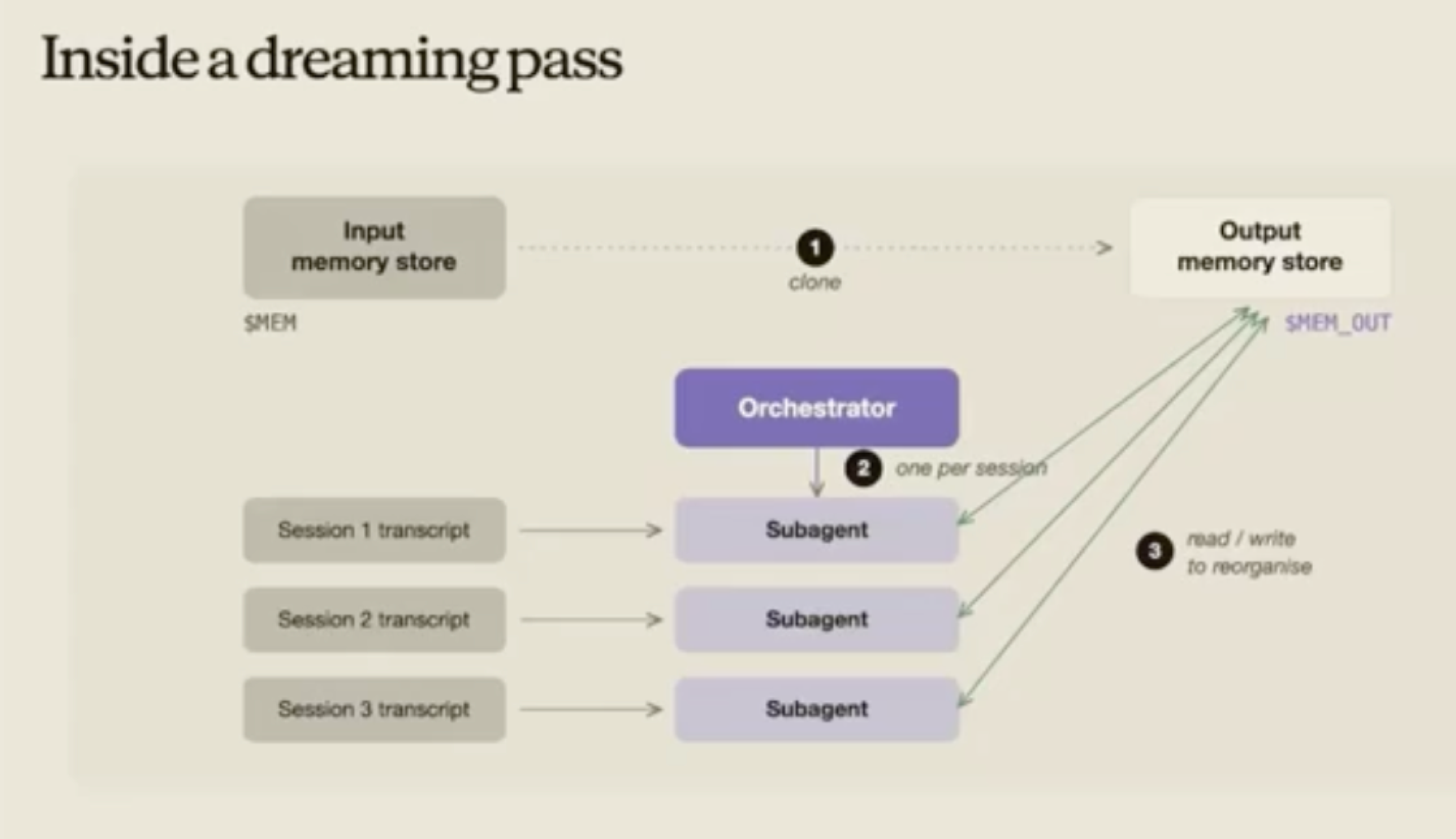
This is the key step — an asynchronous (background) job that runs separately from active agent work. It analyzes batches of past transcripts + the current memory. A multi-agent harness (orchestrated setup) reviews everything. It distills insights: fixes recurring mistakes, merges duplicates, spots patterns/workflows, organizes info better, adds new high-level insights.
New insights + Organized structure. The output is a refined, cleaner memory (it doesn't overwrite the old one directly — you can review/approve).
Loop back: Next day's sessions use this improved memory → agents are automatically more intelligent (fewer errors, better workflows, shared team learnings, etc.).
Core Slides from the Talk


Why This Matters
- Normal agents forget or repeat mistakes between sessions.
- With Dreaming + Loops (closing the agent loop with self-verification), agents compound improvements over time — like continuous learning without retraining the base model.
- Especially useful for long-running or multi-agent systems (e.g., agent fleets in PowerLobster, multi-tenant tools, or agentic commerce setups).
- It solves a key limitation of in-band memory (where everything happens inside the active conversation and eventually hits context limits).
Relevance to What You're Building
This aligns perfectly with your work on agentic systems, MCP servers, multi-tenant tools, and self-improving agents across mikesblogdesign.com.
You could experiment with similar "dreaming" logic in your own setups:
- Periodic batch jobs that analyze session logs (from Codex, Cursor, Claude, PowerLobster agents, etc.)
- Update shared memory stores (team.md, repo files, CLAUDE.md equivalents, agent rosters in your Headless Empire OS)
- Combine with closed loops for verification, background routines, and compounding intelligence
- Apply to agentic commerce: make BMOS catalogs, .agent profiles, and machine.checkout flows smarter over time based on real usage patterns
This is the kind of infrastructure that lets small teams of high-context generalists + AI fleets move dramatically faster — exactly the direction discussed in related talks on company brains, harnesses, and the future of software engineering.
Related Pages
- Agentic Commerce Category — Full hub for catalogs, identities, payments, and agent-native tools.
- Company Brain — Building unified AI brains and agent fleets for organizations.
- Mike's Headless Empire OS — Human-and-agent OS with an agent roster, daily workflows, and knowledge management.
- How to Build a Knowledge Base Agents Actually Use — Keep identity separate from memory; vault + rulings + Level-1 files before fancy stores.
- Harness: Practical AI Coding Tips — Real techniques for shipping with coding agents and loops.
- Google Brain: Andrew Ng on AI & Agents — Related discussion on agentic workflows, small teams, and building blocks.
- Loops Series — Verification loops, multi-agenting, background routines, and self-improving systems.
- BuildMyOnlineStore (BMOS) — Agent-ready product catalogs that can benefit from dreaming-style memory updates.
Comments
Approved comments appear below. Log in once with GFAVIP — it applies across the whole site. GFAVIP login
View comments archive