Domain-Specific Harness
The model reasons. The harness decides what it sees, remembers, can do, and is not allowed to do. That’s the product — not a chat API wrapper.
← AI Agents · Multi-agent harness map · Coding harness tips · CLI for agents · Company brain · Gym hack · SEO loop
Why this slug
/domainharness is the right name on this site.
/harness is already 10 coding-tool tips.
/multi-agent-harness is the company
stack map (QM, Hermes, OpenClaw, Grok Build). This page is the
product thesis: one industry’s control system around
whoever’s model is cheapest this quarter.
Source
Garry Tan (@garrytan) — x.com/garrytan/status/2098666551629267324 (12 Sep 2026):
Either you die a system of record or you live long enough to become a domain-specific harness
Elvis (@omarsar0, DAIR.AI) quoting that — x.com/omarsar0/status/2098809969252450451 (~6.5k bookmarks / ~493k views at capture). YC builders shouldn’t wrap a chat API. They should build a domain-specific harness. Papers: academy.dair.ai/papers/collections/harness-engineering .
Same day,
Harrison Chase
(@hwchase17)
—
x.com/hwchase17/status/2098866608785473858
— “in case you want to build a domain specific harness,” pointing at
Sydney Runkle’s
LangChain post
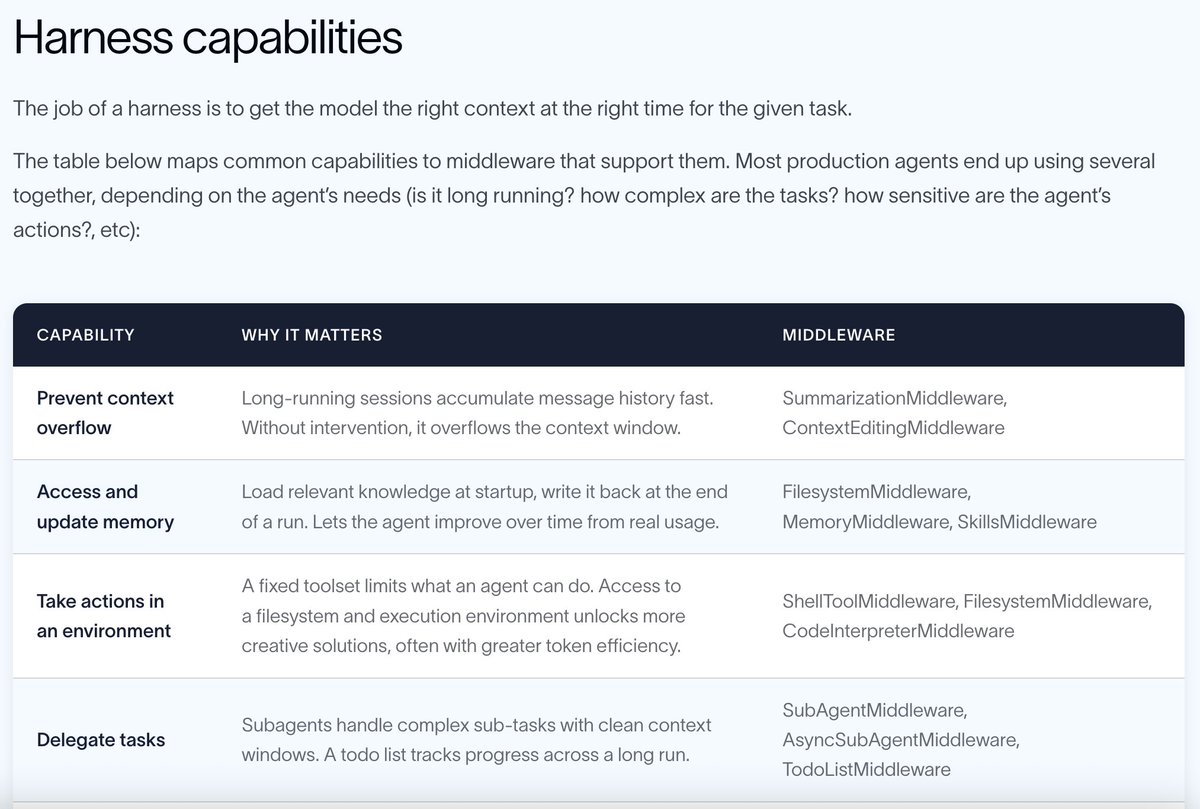
(agent = model + harness, middleware as the knobs).
One-sentence TL;DR
Models swap. The durable company is the outer harness: domain tools, domain memory, domain workflows, and a deny list — so the same weights can run underwriting, diligence, or plant triage without becoming a chatbot with a logo.
Agent = model + harness
Not a physical wire harness. The software layer around a model that turns a general LLM into a working agent. DAIR.AI’s line: a harness is everything between the model weights and the world. Same weights can look mediocre or excellent depending only on that wrapper. Their paper collection exists to show that gap (they put it as roughly 30% vs 95% on the same bench).
A generic agent harness typically owns:
- The loop — plan → call tools → observe → repeat
- Context assembly — what goes in the window, in what order
- Tools and skills — APIs, files, browsers, domain calculators
- Memory and state across steps and sessions
- Sandbox / workspace so actions are isolated
- Guardrails — permissions, approvals, audit logs, don’t-do-this
- Evaluation and recovery when a step fails
Thoughtworks-style split (useful, even if the brand isn’t in the tweets):
| Inner harness | Outer harness | |
|---|---|---|
| Who ships it | OpenAI, Anthropic, Cursor, Codex, Claude Code, LangChain Deep Agents | You — prompts, MCP, skills, policies, product UX |
| Job | “Use a computer”: code, files, search, shell | How this industry actually works |
| On this site | /harness, Claude SDK, Codex engineering | This page. RankingSolution, Email Quarterback, GFAVIP, HEOS. |
Industry-specific work is mostly outer-harness work. The skeptic in Harrison’s thread (“just use Codex and layer skills”) is describing the inner layer. That’s real. It is not the product Garry is talking about.
What “industry-specific” adds
A general harness is good at using a computer. A domain harness encodes the job.
| Layer | Generic | Domain |
|---|---|---|
| Tools | HTTP, files, browser | Statute lookup + facts ledger; SCADA/OPC UA; SEG-Y; XBRL + positions |
| Memory | Chat history | Deals, well logs, claims, SOPs, house playbook |
| Context | “Be helpful” | What “material,” “in spec,” or “reportable event” means here |
| Workflows | One-shot task | Multi-day analysis, four-eye, filing sequence, maintenance window |
| Guardrails | Maybe a system prompt | Read vs write; must stay human; must be auditable; cost cap per run |
Reply in Elvis’s thread: @SatyKrish posted a regulatory-compliance harness — custom fact handling so the agent stays useful and efficient.
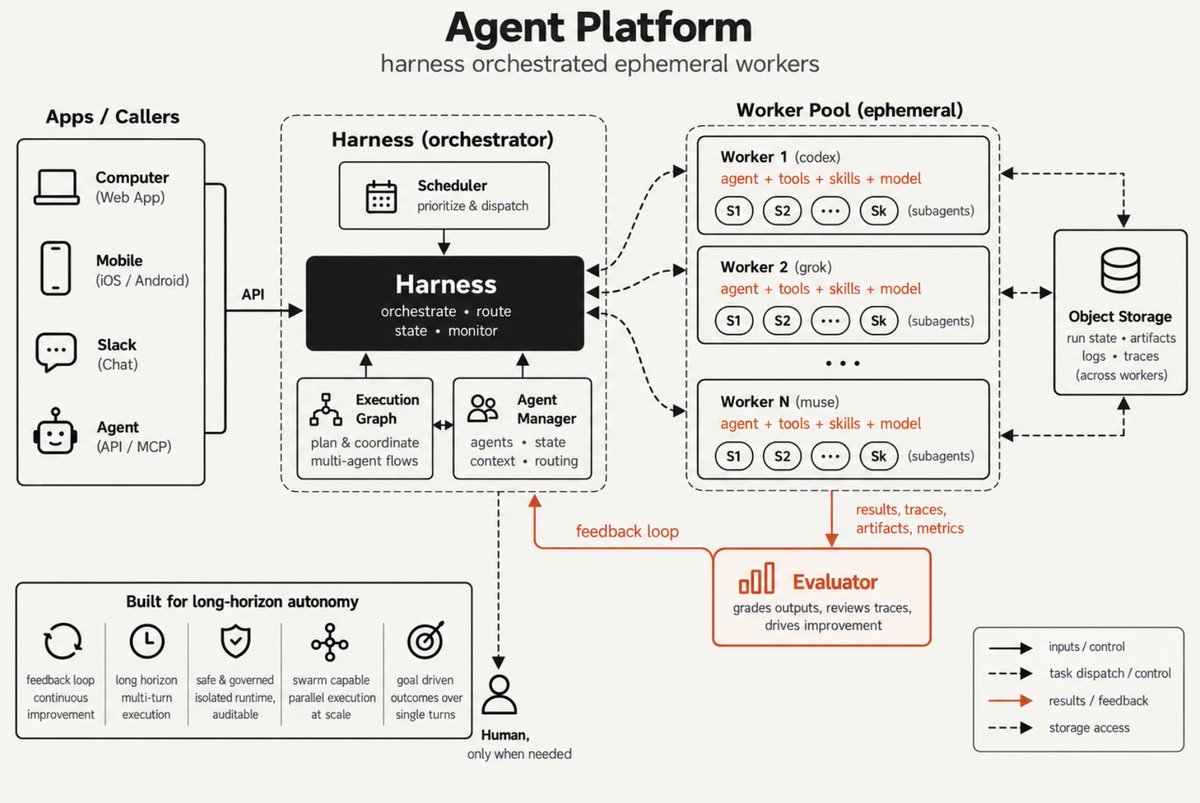
Harrison’s thread, @KakaluoteW45042: the expensive part is not the loop. It’s tool guardrails — irreversible actions need human confirm, writes should be idempotent, every run has a cost cap. The more specific the domain, the narrower the action space, the easier the fences. That is the generic-agent vs domain-harness line. Same spirit as gym hack and Grok Bot Require Approval.
Why people think this is the product
Models are converging and swappable. The durable edge is the stack that knows the domain:
- Reliability on real work, because tools and checks match the job
- New surfaces: not a chatbot, but “run this underwriting / diligence / plant-triage workflow”
- A framework for how customers interact with the service
- Swap models later without throwing away the business logic
Old software companies were systems of record. The next durable product is often the industry-specific harness sitting on top of whoever’s model is best this quarter. Elvis: a “harness wave.” Start by building one for a domain you already know. Generic coding harnesses (Claude Code, Codex, Cursor) already proved the pattern for software. The bet is law, healthcare, energy, insurance, manufacturing, vertical SaaS next.
A concrete picture
Generic agent: “Summarize this PDF.”
Private-credit harness, same model family:
- Pull the deal room with the right permissions
- Extract covenants into a structured checklist
- Compare against the firm’s playbook
- Flag conflicts with existing portfolio exposure
- Draft a memo in the house template
- Stop before anything is sent or booked, and log every tool call
Completely different product, because the harness owns data access, procedure, memory, and brakes.
How LangChain would build it (Harrison’s pointer)
Runkle’s post: the job of a harness is to deliver the right context at
every step. Deep Agents / Claude Agent SDK are pre-assembled inner
stacks. create_agent is the thin loop; middleware
is how you customize — before/after model, before/after tools, startup
and teardown. That’s where PII checks, human-in-the-loop, call limits,
retries, and summarization live. They don’t belong in a prompt.
Useful skeptic in that thread: when summarization middleware compresses mid-run, does the model know it lost something? If you don’t surface that, the outer harness is lying to itself. Log compaction. Don’t pretend the window is still the whole deal.
How this maps here
We already have fragments of outer harnesses. The miss is treating them as chatbots or as “install Cursor.”
| Domain we actually know | Harness-shaped piece | Still missing |
|---|---|---|
| Portfolio SEO | seoloop + RankingSolution + fan-outs | Deny list on publish; cluster as the brief; judgment job that can’t be skipped |
| Inbox / CS | Email Quarterback | Tool-shaped assign/close, not “summarize the mailbox” |
| Ecommerce SKUs | Product brain / theflysales | Per-product memory that survives the session |
| Membership | GFAVIP agents / webchat | Identity + perks as tools, not a general bot with a VIP skin |
| Company OS | Company brain · HEOS · HQ for Work | Policies as code; inner harness (Grok Build / Codex) underneath, not instead |
| Apple shipping | ASC CLI | That’s a domain CLI inside a harness, not the whole harness |
GrokBot CEO + Require Approval is org-shaped outer harness. Don’t spawn a “SEO chatbot” that bypasses seoloop Memory.
Week-one sitting (don’t wrap ChatGPT)
- Pick one domain you already run (SEO, inbox, or one SBU). Not five.
- Write the deny list first: send, delete, spend, merge, publish, auth. Same as gym hack / Grok Auto-review.
- List 5–8 domain verbs (not 40 API endpoints). Prefer a CLI.
- Name the memory: what must survive the session (playbook, changelog, facts ledger).
- One workflow that stops before the irreversible step and logs the tool calls.
- Feed Elvis’s paper list to an agent for reading notes. Don’t start a new inner harness if Codex/Claude Code already loops.
What we keep vs skip
- Keep: Garry’s line; outer vs inner; deny list next to tools; domain memory; stop-before-send; log every call; swap models.
- Verify: whether RankingSolution’s MCP is a harness or just a tool dump; whether Grok Bot plugins are account-wide (they are — don’t confuse plugin with domain).
- Skip: wrapping ChatGPT and calling it a vertical; rebuilding Claude Code for law on week one; putting guardrails only in the system prompt; “just Codex + skills” as the whole company.
Related on this site
- Multi-agent harness map — QM / Hermes / OpenClaw / Grok Build as inner or company runtimes
- Harness coding tips — how to sit in the inner harness
- CLI for agents — task-shaped tools the outer harness should call
- Gym hack · Require Approval — the deny list
- SEO loop · Query fan-out — SEO as a domain
- Company brain · HQ for Work · Email Quarterback
- Codex engineering · Claude Agent SDK
Primary: Garry Tan · @omarsar0 · @hwchase17 · DAIR papers · LangChain how-to
Field notes · September 2026 · Outer harness is the product · @garrytan
Comments
Approved comments appear below. Log in once with GFAVIP — it applies across the whole site. GFAVIP login
View comments archive