The 5 Levels of High Agency: Why Level 4+ Is the Minimum for Modern Teams and AI Agents
A simple pyramid that separates low-agency issue reporters from true problem solvers — and why it’s essential for 2026 teams and autonomous AI agents.
← Part of the AI Agents knowledge base
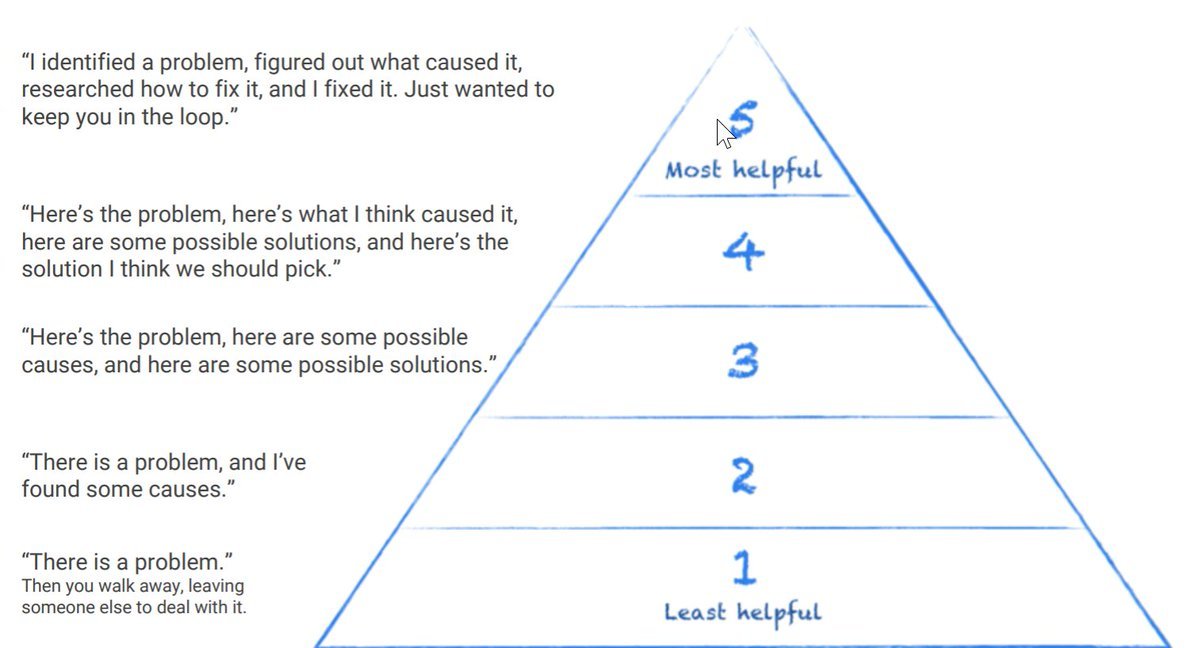
The 5 Levels of High Agency Pyramid. Concept originally from @stephsmithio, popularized by @businessbarista.
A few days ago, this tweet from Alex Lieberman exploded across my feed (and apparently the entire internet — nearly 7k likes and 10k+ bookmarks at the time of writing).
It’s a simple pyramid diagram breaking down the 5 Levels of Work — originally shared by Steph Smith — and it’s one of the cleanest frameworks I’ve seen for explaining high agency.
The 5 Levels Explained
Here’s the core idea:
- Level 1: “There is a problem.” (Then you walk away, leaving someone else to deal with it.)
- Level 2: “There is a problem, and I’ve found some causes.”
- Level 3: “Here’s the problem, here are some possible causes, and here are some possible solutions.”
- Level 4: “Here’s the problem, here’s what I think caused it, here are some possible solutions, and here’s the one I think we should pick.”
- Level 5: “I identified a problem, figured out what caused it, researched how to fix it, and I fixed it. Just wanted to keep you in the loop.”
Alex’s advice to new employees: You will live at Level 4 from Day 1. As trust builds, you rise to Level 5.
Why This Resonates So Deeply Right Now
I’ve been talking about extreme agency for a while — it’s one of the highest-leverage skills anyone can develop in the AI era. Tools are getting more powerful by the week (Claude, custom MCP servers, agent orchestration platforms, etc.), but tools without agency are just expensive toys.
The difference between a junior team member (or a basic AI script) and a senior operator often isn’t raw skill. It’s the willingness and ability to own the outcome instead of just surfacing issues.
Look at the replies to Alex’s tweet — dozens of people shared stories of corporate environments where Level 4/5 behavior gets punished instead of rewarded. Middle management that wants to stay in the loop on every decision. Processes designed to prevent independent action. That’s the opposite of what we need.
How I’m Applying This at HeadlessDomains, PowerLobster & Beyond
When I’m hiring for roles like Distribution Engineer (AI Infrastructure Builder) or future Agent Operator positions, I’m explicitly looking for Level 4 and Level 5 signals in people’s stories.
I don’t want someone who just flags that “the domain registration webhook is failing.” I want the person (or AI agent) who says:
“The webhook is failing on Handshake .agent domains because of a rate limit on the provider side. I tested switching to the backup resolver, confirmed it resolves the issue in staging, and pushed the config change. Monitoring looks clean now — here’s the PR and the brief incident report.”
That’s Level 5. And that’s what scales.
We’re applying the same thinking to the AI agents we’re building:
- Our agents don’t just report “there’s a problem with this .agent domain registration.”
- They diagnose the root cause (wallet balance, HNS node sync, MPP compliance issue, etc.).
- They propose or autonomously execute the fix.
- They log what happened and surface only what a human actually needs to review.
This is the future of agentic commerce. Sovereign AI agents that operate at Level 5 so founders and operators can focus on higher-order problems.
The Trust Layer (The Hidden Requirement for Level 5)
One of the most important (and under-discussed) parts of Alex’s post is this line:
“You will live at Level 4 from Day 1 and as we build trust you will rise to Level 5.”
Level 5 only works in environments where people feel safe to act without asking permission for every move. If your culture punishes initiative or requires 3 approvals for a one-line config change, you’ll never get Level 5 output — you’ll get Level 3 at best, with a lot of theater around “visibility.”
This is why I’m so focused on building Headless Agentic Company OS principles into how we work: GitHub as the source of truth, direct-to-main merges for speed (with clear conventions), async-first communication, and clear ownership.
When trust is high and context is shared, Level 5 becomes the default.
Level 5 AI Agents: The Real Multiplier
Here’s where this gets exciting for those of us building in public.
If human team members at Level 5 are 10x more valuable than Level 1-3, then Level 5 AI agents are 100x.
We’re already seeing early versions:
- Agents that register and manage .agent domains end-to-end
- Agents that handle payments via Stripe Link / MPP / x402 without human intervention
- Agents that post updates, monitor systems, and self-heal infrastructure
The winners in the next 2–3 years won’t be the companies with the most agents. They’ll be the ones whose agents reliably operate at Level 4 and 5 — identifying real problems in agentic commerce flows, diagnosing them correctly, choosing smart solutions, executing, and keeping the human in the loop with crisp summaries.
Everything else is just expensive Level 1–2 noise.
Steal This Framework
Alex said it best: “Plz feel free to steal it as well.”
Here’s how I recommend using it immediately:
- Onboarding: Print the pyramid. Walk new team members (and new AI agent prompts) through the 5 levels explicitly.
- Performance conversations: Ask people to share recent examples of Level 4 or 5 work they’ve done. Celebrate the Level 5 wins publicly.
- AI agent design: When building or prompting agents, explicitly instruct them to aim for Level 5 behavior. “Don’t just report the error — diagnose, propose or apply the fix, and summarize.”
- Self-audit: Where are you operating most of the time? Most founders I know default to Level 5 on their own projects… and then accidentally create Level 2–3 environments for their teams.
Final Thought
The best teams (and the best AI systems) don’t just find problems. They own them end-to-end.
In a world of accelerating AI capability, the humans and agents who consistently operate at Level 4 and Level 5 will be the ones who actually move the needle — whether that’s launching the next wave of .agent domains, scaling agentic checkout flows, or building the infrastructure that lets sovereign agents do real work.
This simple pyramid might be the highest-leverage hiring and design tool you add to your stack this year.
What level are most of the people (and agents) around you operating at right now? And more importantly — what would it take to get them to Level 5?
I’d love to hear your Level 5 stories in the comments or on X.
Related: The Neuroscience of Manifestation
High agency is the engine. Learning how to intentionally direct it is the next level. Read How to Manifest with Neuroscience — Dr. James Doty’s breakdown of how to embed goals into your subconscious using multi-sensory techniques.
References & Credits
- Original tweet: @businessbarista – The 5 Levels of High Agency
- Framework credit: @stephsmithio
- Related: Extreme Agency: The #1 AI-Era Skill — My earlier deep dive on developing high agency.
- Related: Distribution Engineer role — We explicitly hire for Level 4+ thinking.
- Related: The 5 Roles in AI-First Companies — Boris Cherny's archetypes for hiring and team design in AI-native orgs.
- Related: Company Brain and Mike’s Headless Empire OS — Building systems that support Level 5 work.
About the Author
Mike Michelini is an entrepreneur building at the intersection of agentic commerce, decentralized domains (.agent gTLDs on Handshake), and AI agent infrastructure. He runs HeadlessDomains, PowerLobster, and organizes the Cross Border Summit. Based in Chiang Mai, he writes about extreme agency, shipping real products, and the future of autonomous systems.
Comments
Approved comments appear below. Log in once with GFAVIP — it applies across the whole site. GFAVIP login
View comments archive